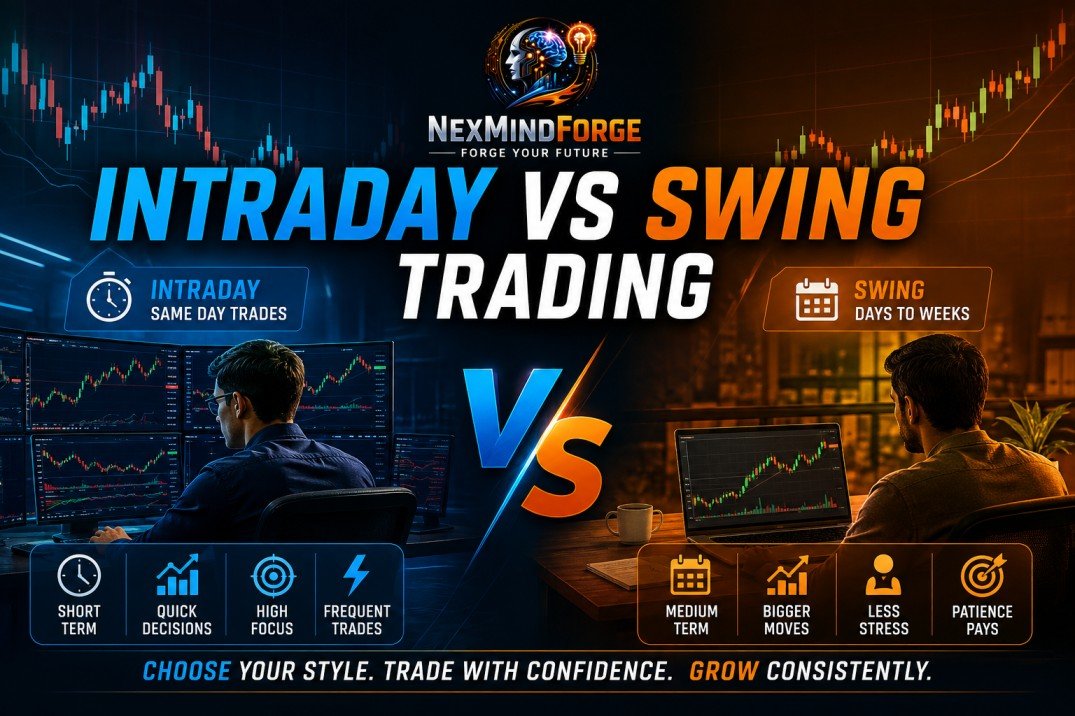
Intraday vs Swing Trading
Choosing the right trading style is one of the most important decisions every trader must make. Many beginners enter the market without understanding the difference between Intraday vs Swing Trading, which often leads to poor decisions, emotional trading, and unnecessary losses.
Both trading styles can be profitable when used with proper knowledge, discipline, and risk management. However, they are designed for different personalities, lifestyles, and market conditions.
In this comprehensive guide, you’ll learn the key differences between intraday and swing trading, their advantages and disadvantages, capital requirements, risk levels, and how to decide which trading style suits your goals.
If you’re completely new to the stock market, we recommend reading our complete guide on What is Stock Market? before choosing your trading style.
What is Intraday Trading?
Intraday Trading means buying and selling financial instruments such as stocks, options, futures, or commodities within the same trading day. All open positions are closed before the market closes, ensuring that no trade is carried overnight.
The primary goal of intraday trading is to capture small price movements that occur during market hours.
Example
Suppose you buy 100 shares of XYZ Company at ₹500 in the morning. During the afternoon, the stock rises to ₹507. You sell all shares before market closing and book your profit. Since the trade was completed on the same day, it is considered an intraday trade.
Characteristics of Intraday Trading
- Trades are completed within the same trading session.
- No overnight market risk.
- Requires continuous market monitoring.
- High trading frequency.
- Suitable for active traders.
- Often uses leverage provided by brokers.
- Requires fast execution and decision-making.
Advantages of Intraday Trading
- Daily profit opportunities.
- No overnight gap risk.
- Efficient capital utilization.
- Multiple trading opportunities every day.
- Immediate learning through market experience.
Disadvantages of Intraday Trading
- Requires full attention during market hours.
- Can be mentally exhausting.
- Higher brokerage costs due to frequent trading.
- Emotional decisions may lead to losses.
- Risk management becomes extremely important.
What is Swing Trading?
Swing Trading involves holding positions for several days or even weeks to capture medium-term market movements. Unlike intraday trading, swing traders allow trades to remain open overnight.
The objective is to profit from larger price movements rather than small daily fluctuations.
Example
You buy a stock at ₹1,000 after identifying a strong bullish breakout. Instead of selling the same day, you hold the position for ten days. The stock reaches ₹1,120, and then you book your profit.
This is a classic example of swing trading.
Characteristics of Swing Trading
- Trades last several days or weeks.
- Captures medium-term trends.
- Requires less screen time.
- Ideal for working professionals.
- Focuses on quality setups instead of quantity.
- Requires patience and discipline.
Advantages of Swing Trading
- Less stressful than intraday trading.
- Flexible schedule.
- Suitable for part-time traders.
- Can generate larger profits from strong trends.
- Lower brokerage costs due to fewer trades.
Disadvantages of Swing Trading
- Overnight gap risk.
- Capital remains locked for longer periods.
- Requires patience.
- Market news can affect open positions.
- Not suitable for traders seeking daily income.
Intraday vs Swing Trading: Key Differences
| Feature | Intraday Trading | Swing Trading |
|---|---|---|
| Holding Period | Same Day | Several Days to Weeks |
| Risk | High | Moderate |
| Screen Time | High | Low |
| Overnight Risk | No | Yes |
| Trading Frequency | Very High | Medium |
| Stress Level | High | Lower |
| Suitable For | Full-Time Traders | Working Professionals & Beginners |
| Profit Target | Small Daily Moves | Larger Trend Moves |
Timeframe Used in Intraday vs Swing Trading
The choice of timeframe plays a major role in trading success.
- Intraday Traders: 1 Minute, 3 Minute, 5 Minute, 15 Minute and 30 Minute charts.
- Swing Traders: 1 Hour, 4 Hour, Daily and Weekly charts.
If you’re confused about selecting the right chart timeframe, read our complete guide on Best Timeframe for Trading. It explains how different chart timeframes impact trade accuracy and overall performance.
Capital Requirement
One of the biggest differences in Intraday vs Swing Trading is capital management.
- Intraday Trading: Can often be started with relatively lower capital because brokers may provide leverage. However, leverage also increases risk significantly.
- Swing Trading: Generally requires more capital since positions are held overnight and leverage is usually lower. The advantage is that trades have more time to develop and reach larger profit targets.
Choosing the right trading style depends not only on your capital but also on your experience, discipline, and ability to manage risk effectively.
Who Should Choose Intraday Trading?
Intraday trading is best suited for people who can dedicate several hours every trading day to monitoring the market. Since positions are opened and closed on the same day, traders must react quickly to price movements and market conditions.
You should consider intraday trading if you:
- Can actively monitor the market during trading hours.
- Enjoy making quick decisions.
- Have strong discipline and emotional control.
- Are comfortable with frequent trades.
- Can strictly follow stop-loss and risk management rules.
Who Should Choose Swing Trading?
Swing trading is ideal for people who cannot spend the entire day watching charts. It allows traders to analyze the market after work and hold positions for several days.
Swing trading may be suitable if you:
- Have a full-time job or business.
- Prefer lower stress trading.
- Like holding trades for multiple days.
- Can patiently wait for quality setups.
- Want to capture larger market trends.
Risk Management in Intraday vs Swing Trading
No trading strategy can remain profitable without proper risk management. Whether you choose intraday or swing trading, protecting your capital should always be your highest priority.
- Never risk more than 1–2% of your trading capital on a single trade.
- Always use a predefined stop-loss.
- Maintain a favorable Risk-to-Reward Ratio such as 1:2 or 1:3 whenever possible.
- Avoid overtrading after consecutive losses.
- Keep a trading journal to review your mistakes and improve consistently.
Common Mistakes Beginners Make
Many beginners fail not because of a lack of knowledge, but because of poor trading habits.
- Trading without a proper plan.
- Ignoring stop-loss orders.
- Using excessive leverage.
- Taking revenge trades after losses.
- Following random tips from social media.
- Changing strategies every few days.
- Overtrading to recover losses.
- Ignoring market psychology.
Can You Do Both Intraday and Swing Trading?
Yes. Many experienced traders combine both trading styles to diversify their opportunities.
For example, a trader may use swing trading to capture long-term market trends while taking selective intraday trades when high-probability setups appear. However, beginners are generally advised to master one trading style before attempting to manage multiple strategies.
Which Trading Style is More Profitable?
There is no universal answer to this question. Profitability depends on your knowledge, discipline, trading psychology, and risk management—not simply on whether you choose intraday or swing trading.
A disciplined swing trader can consistently outperform an emotional intraday trader, while a skilled intraday trader may generate regular income through well-planned daily trades.
The best trading style is the one that matches your personality, available time, financial goals, and ability to follow a trading plan consistently.
Frequently Asked Questions (FAQ)
Is Intraday Trading Better Than Swing Trading?
Not necessarily. Intraday trading offers daily opportunities but requires continuous market monitoring. Swing trading provides more flexibility and is generally easier for working professionals.
Can Beginners Start with Swing Trading?
Yes. Many beginners prefer swing trading because it allows more time for market analysis and reduces the pressure of making instant decisions.
Which Trading Style Requires More Time?
Intraday trading requires significantly more screen time than swing trading because positions are managed throughout the trading session.
Which Trading Style Has Higher Risk?
Intraday trading often carries higher short-term risk due to market volatility and leverage. Swing trading involves overnight gap risk but generally requires fewer trades.
Can I Switch Between Both Trading Styles?
Absolutely. As your experience grows, you can adapt your trading style according to changing market conditions and personal preferences.
Final Thoughts
Understanding Intraday vs Swing Trading is essential before risking your hard-earned money in the financial markets. Both approaches have unique advantages and challenges, and neither is inherently better than the other.
If you enjoy fast-paced decision-making and can dedicate full attention during market hours, intraday trading may suit you. On the other hand, if you have limited time and prefer a more relaxed approach, swing trading can be an excellent choice.
Regardless of the trading style you choose, success ultimately comes from continuous learning, disciplined execution, effective risk management, and emotional control. Focus on building a solid trading process rather than chasing quick profits, and your long-term performance will improve significantly.
Disclaimer: This article is for educational purposes only and should not be considered financial or investment advice. Trading in financial markets involves risk, and past performance does not guarantee future results. Always conduct your own research and consult a qualified financial advisor before making investment decisions.