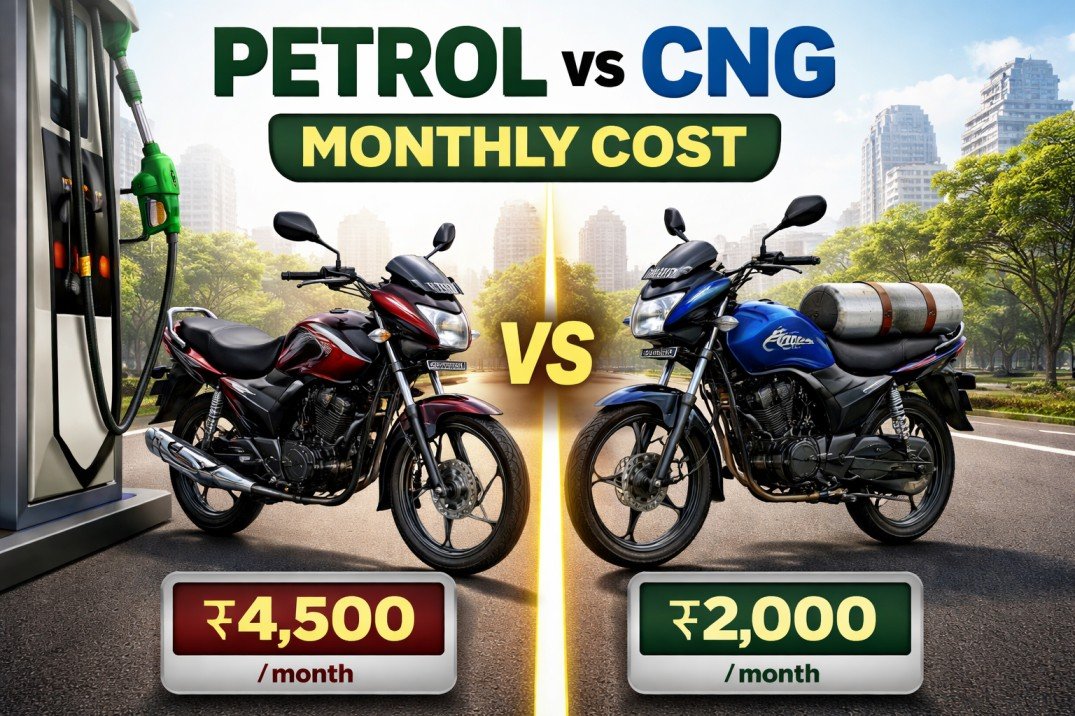
Why Compare Petrol vs CNG Bike Running Cost in 2026?
If you’re riding a bike every day in a city like Varanasi, fuel costs can eat up a big chunk of your pocket money or salary. With prices always changing and new options like CNG bikes hitting the roads, it’s smart to crunch the numbers. In 2026, the Bajaj Freedom 125 and similar dual-fuel models have made CNG a real choice for commuters who do 50-100 km daily. Petrol bikes are still everywhere – reliable, quick refuel, no waiting – but CNG promises massive savings if you have stations nearby. This post breaks down the real monthly running cost for petrol vs CNG bikes, using actual 2026 prices, real-world mileage from owners, and simple calculators. No theory – just what you’ll actually pay at the end of the month. Let’s see how much you can save (or not) switching fuels.
Current Fuel Prices in India (February 2026)
Fuel prices vary by city due to taxes, but here’s a snapshot from major sources as of mid-February 2026:
- Petrol: Around ₹94-₹105 per litre (Delhi \~₹94.7, Mumbai \~₹103.5, Varanasi/UP average \~₹95-₹100)
- CNG: Around ₹80-₹93 per kg (UP/V aranasi area often \~₹90-₹91/kg, some stations lower at \~₹81 in pockets)
For fair comparison, we’ll use realistic averages for UP/North India: Petrol ₹97/litre, CNG ₹90/kg. These are close to what most riders pay right now – check your local pump for exacts, as they fluctuate daily.
Real-World Mileage: Petrol vs CNG Bikes
Mileage makes or breaks savings. Here’s what owners and tests report in 2026 for typical 100-125cc commuters:
| Bike Type | Examples | Real-World Mileage | Notes |
|---|---|---|---|
| Petrol (100-125cc) | Honda Shine 100/125, Hero Splendor, TVS Raider, Bajaj Platina | 55-70 kmpl (city/mixed) | 60-65 kmpl common in gentle riding; drops to 50-55 with aggressive throttle or traffic |
| CNG (Dual-Fuel like Bajaj Freedom 125) | Bajaj Freedom 125 | 85-100 km/kg on CNG (real-world 85-95 km/kg city) | Claimed 100 km/kg; owners get 90+ with calm riding; petrol backup \~50-60 kmpl |
CNG bikes shine in efficiency per unit fuel, but remember: CNG mode has slightly less power, so some riders switch to petrol for hills or quick overtakes. For pure commuting, CNG dominates savings.
Running Cost Calculator: Monthly Savings Breakdown
Let’s calculate monthly fuel cost for different daily rides (assume 25 working days/month = \~750-3000 km/month). Using Petrol ₹97/litre, CNG ₹90/kg.
| Daily Km | Monthly Km | Petrol Cost (60 kmpl avg) | CNG Cost (90 km/kg avg) | Monthly Savings with CNG | Savings % |
|---|---|---|---|---|---|
| 30 km | 750 km | ₹1,213 (12.5 litres) | ₹750 (8.33 kg) | ₹463 | 38% |
| 50 km | 1,250 km | ₹2,021 (20.8 litres) | ₹1,250 (13.9 kg) | ₹771 | 38% |
| 80 km | 2,000 km | ₹3,233 (33.3 litres) | ₹2,000 (22.2 kg) | ₹1,233 | 38% |
| 100 km | 2,500 km | ₹4,042 (41.7 litres) | ₹2,500 (27.8 kg) | ₹1,542 | 38% |
Formula used: Monthly Cost = (Monthly Km / Mileage) × Fuel Price. Savings stay around 35-40% consistently because CNG is cheaper per energy unit and bikes are tuned efficiently.
Real-Life Examples for Daily Riders
For a student or office goer doing 40-50 km daily in Varanasi traffic: Petrol bike might cost ₹1,600-2,000/month in fuel. Switch to CNG like Bajaj Freedom: drops to ₹1,000-1,200 – saving ₹500-800 every month. Over a year, that’s ₹6,000-10,000 back in your pocket for groceries or savings.
High-mileage rider (delivery or long commutes, 80+ km/day): Petrol \~₹3,000-3,500/month vs CNG \~₹1,800-2,200 – huge ₹1,000+ monthly win. But if CNG stations are far or queues long, petrol’s convenience might outweigh for some.
Want more on petrol efficiency? Check the Honda Shine 100 cc 2026 launch for a classic high-mileage option. Or for sportier rides, see the Yamaha RX 110 launch news India.
And for broader two-wheeler fuel choices, our earlier post on Petrol vs Electric vs CNG Two-Wheelers 2026 covers EVs too if you’re thinking beyond petrol/CNG.
Other Factors Affecting Monthly Costs
- Maintenance: CNG bikes have dual systems – slightly higher servicing (\~₹500-1,000 extra/year), but brakes last longer due to lighter throttle use.
- Upfront Cost: CNG models like Freedom 125 cost ₹10,000-20,000 more than similar petrol bikes – payback in 1-2 years for high mileage.
- Convenience: Petrol anywhere, CNG needs stations (good in UP, but plan routes).
- Riding Style: Aggressive riding drops mileage 10-20% for both.
- Insurance/Resale: Similar, but CNG might hold value better as fuel prices rise.
Pros and Cons: Petrol vs CNG for Monthly Running
| Aspect | Petrol Bike | CNG Bike |
|---|---|---|
| Monthly Fuel Cost (50 km/day) | ₹1,800-2,200 | ₹1,100-1,400 |
| Refueling Time | 2-3 min | 5-10 min + queues sometimes |
| Power/Performance | Better pickup | Slightly less on CNG mode |
| Availability | Everywhere | Station-dependent |
| Long-Term Savings | Decent | High for 50+ km/day |
Final Verdict: Which Saves More Per Month?
In 2026, for most daily riders doing 40+ km, CNG bikes win hands-down on running cost per month – often ₹500-1,500 savings depending on distance. If you live in a CNG-heavy area like Uttar Pradesh, have a predictable route, and don’t mind the slight power trade-off, switching could cut your fuel bill by 35-40%. Petrol remains king for low-mileage, occasional riders, or where stations are scarce. Do the math for your km: divide your monthly distance by mileage, multiply by price – the difference will surprise you. Test ride a CNG model soon; the savings feel real when the bill comes. Ride smart, save big!